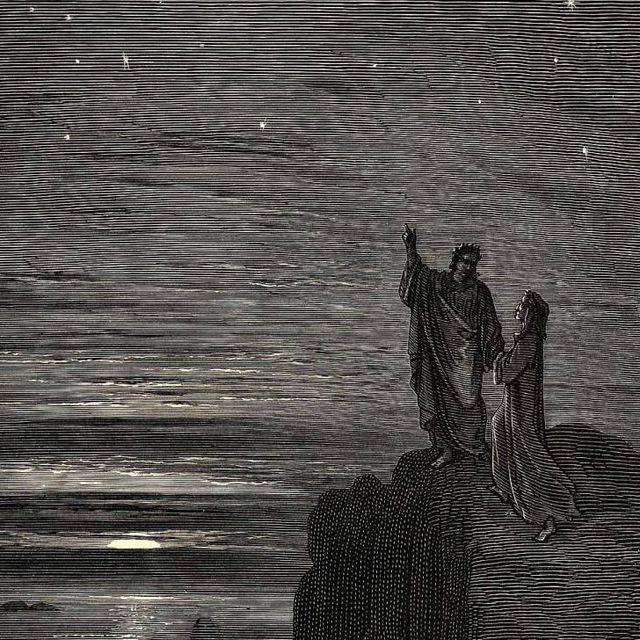
"...there have always been solitary wanderers on the edges of society. Strange figures who renounced the ordinary rhythm of life to devote themselves to the search for meaning, creativity, earthly discoveries, prayer, or dialogue with the divine. In freedom they see a chance to be authentic. In worldly conflicts they often remain neutral observers. Watching from the side, they become witnesses to the great cycle of life. Only a few of them ever step out of the shadows in search of final peace. While others fight for justice or personal gain, these people quietly write chronicles."  ...эти чудаковатые скитальцы-одиночки отреклись от суетного и обыденного, чтобы посвятить жизнь поиску новых смыслов, творчеству, земным открытиями, проповеди или общению с Богом. В свободе они видят возможность быть подлинными, а в спорах мирских зачастую принимают нейтральную сторону. Наблюдая со стороны, они становятся настоящими свидетелями круговорота жизни, и лишь немногие из них предпочитают выйти из тени на пути к вечному покою. Пока другие сражаются за справедливость или ради собственной выгоды, такие люди попросту пишут летописи.
The road is an endless struggle with yourself
The road is a mirror. It forces confrontation with the small tyrant inside — the ego that demands importance, recognition, and meaning. Expectations are the seed of suffering: we want because we think our wants define us. The traveler's remedy is simple and brutal: move. Movement humbles. It reveals how small and porous any self-conception really is.
A warrior of the path lives in action. To be a warrior is not to seek violence but to cultivate discipline: to act, to practice, to test one's limits. To live on fly. The way tempers the ego through repeated exposure to the unknown. I greet insults with a dry "thank you,” not out of masochism but as a ritual of deflation. There is nothing worse than the feeling of self-importance; it is the easiest corruption. I aim instead for a resilient humility — not a denial of value, but a refusal to let that value be fragile and dependent on praise.
Courage on the road is mostly courage to be ordinary. You fall, you get up, you keep walking. In that rhythm, strength accumulates.
Fight yourself, not others. The real conflict is internal. The road sharpens that inner debate: will you retreat into comfort or push outward toward disciplined action? I am happiest wherever I am, but the road heightens that happiness. The thrill of the unknown is a form of self-inquiry. Each unknown teaches something about fear, about desire, about what you can carry.
To travel alone is to practice reliance on strangers and on one's own capacity to adapt. It is an exercise in trust — in people, and in the world's softer edges. It is an experiment that repeatedly shows the world is more helpful, and more beautiful, than the headlines suggest.
We are here to explore — not just the outside world, but the interior landscape that opens when we leave the familiar behind. This is an adventurer's diary dedicated to nomadic life, ascetic practice on the road, vagabond culture, and the strange, beautiful cinema of days spent moving. I write to provoke curiosity: a mixture of dark ambient stillness, Zen quiet, deliberate foolishness, and the ragged freedom of rock 'n' roll. Think of these wanderings as a pilgrimage. I cultivate playful irreverence in the name of inner peace and sharpened perception.
Motion is the most reliable remedy for a restless soul. When you move, opportunities multiply — luck, if you like, is the probability of meeting chance and acting on it. Staying put reduces the number of possibilities; leaving increases them exponentially. Travel, especially in a minimalist style, forces you into social economies that surprise you: sometimes your needs are met without money, by conversation or human generosity. In certain places I've learned that being present is more valuable than being settled: on the road you often receive what city life would charge you for.
When I was in the Caucasus, I discovered that being grounded in one place brings its own series of costs: rent, utilities, routines. On the road, paradoxically, life sometimes became cheaper and fuller.
For me, travel is spiritual practice: a Zen-style pilgrimage where the world becomes a mirror for the soul. The more I see, the more I understand who I am; every new face, every different custom, expands the internal map and diminishes the ego's certainties. Contemplation and movement form a loop: looking outward clarifies inward, and vice versa.
My intention is modest: to fit everything I need into a single backpack and keep the world as my home. Minimal possessions force maximal attention. This is not romantic poverty; it is deliberate freedom.
The will to discover
Life is an investigation. We live in the richest possible era for curiosity: tools, transport, and information make exploration feasible in ways previous generations could have only imagined. There are still uncharted territories on our planet and, quite possibly, beyond it. In another life I imagine myself as a seafarer — a cartographer of winds and currents, a person dedicated to long expeditions. Lately I even dream such voyages; waking with the taste of sea salt and maps in my head.
Travel intensifies life. It makes details larger and more meaningful, stretches time so moments feel thicker. The world is full of kind, generous people; news compresses attention toward the rare and loud tragedies, but everyday reality is mostly small kindnesses and simple decencies. Be generous and open, and the world will respond in kind.
What I was seeking in the past could not be bought or easily found. Those discoveries came to me through attention and patience. To see the world, walk it. Hitchhiking and walking — not cocooned by your own car — force encounters and interruptions. When you travel alone you must rely on others, and this requirement reveals how people respond to strangers. Those responses teach you something essential about human nature and, importantly, about yourself.
I am traveling now toward the Mediterranean. Watching raindrops on glass, I realize the road is my best meditation.
Travel alone — not to run, but to return whole. Travel should not be an attempt to outrun yourself. Setting out in search of meaning when you are profoundly unhappy is a gamble: sometimes it helps, often it amplifies confusion. Enter the journey whole, or at least with the work of becoming whole already started. Learn to be content with yourself, to carry your own company; otherwise the road can become a roulette of chance encounters that leave you lonelier than when you began.
"Wherever you go, there you are" is a blunt but true rule. Bring the work of being happy with you, and travel will offer perspective rather than bewilderment.
For years my dreams have repeated a single motif: walking alone through wild places — forests, mountains, rivers, the ocean's edge. It's a meditative state that mirrors moments of mindful attention in waking life. In dreams I notice small details — leaves, blades of grass, light on a petal — and keep moving. That practice of gentle noticing is at the core of pilgrimage.
Keep your childlike curiosity alive
Somewhere within every adult lives a great explorer. If I ever have a child, the most precious thing I could give is curiosity — the habit of asking questions and the guts to follow the answers into unfamiliar places. Curiosity is not escape. It is a disciplined attention that keeps the mind open and alive.
As a boy I obsessed over the idea of will. I imagined it as a thin, golden current — a moving, luminous matter that animates action. Some people seemed to hold reservoirs of it; others less so. To me, every human act was the release of will into the world, an exchange that never emptied the source entirely. Today, when asked how I visualize the soul, I point toward the world rather than to a bounded interior. The soul, in my vision, is not a private object but a field of consciousness that pervades what is observed. If you insist on a picture, point at a head: it is the most recognizable symbol for people. Or point at any tree, stone, or river — the observer will decide what "soul" means to them. The essential point is the same: consciousness is vast, porous, and not confined.
I love deserts and barren landscapes for this reason. They are honest places. Without the distraction of abundance, the subtle textures of perception stand out.
Be curious. Travel thoughtfully. Keep walking.